
How Long Should Home Appliances Last in Jupiter FL? (And Why the Answer Might Surprise You)
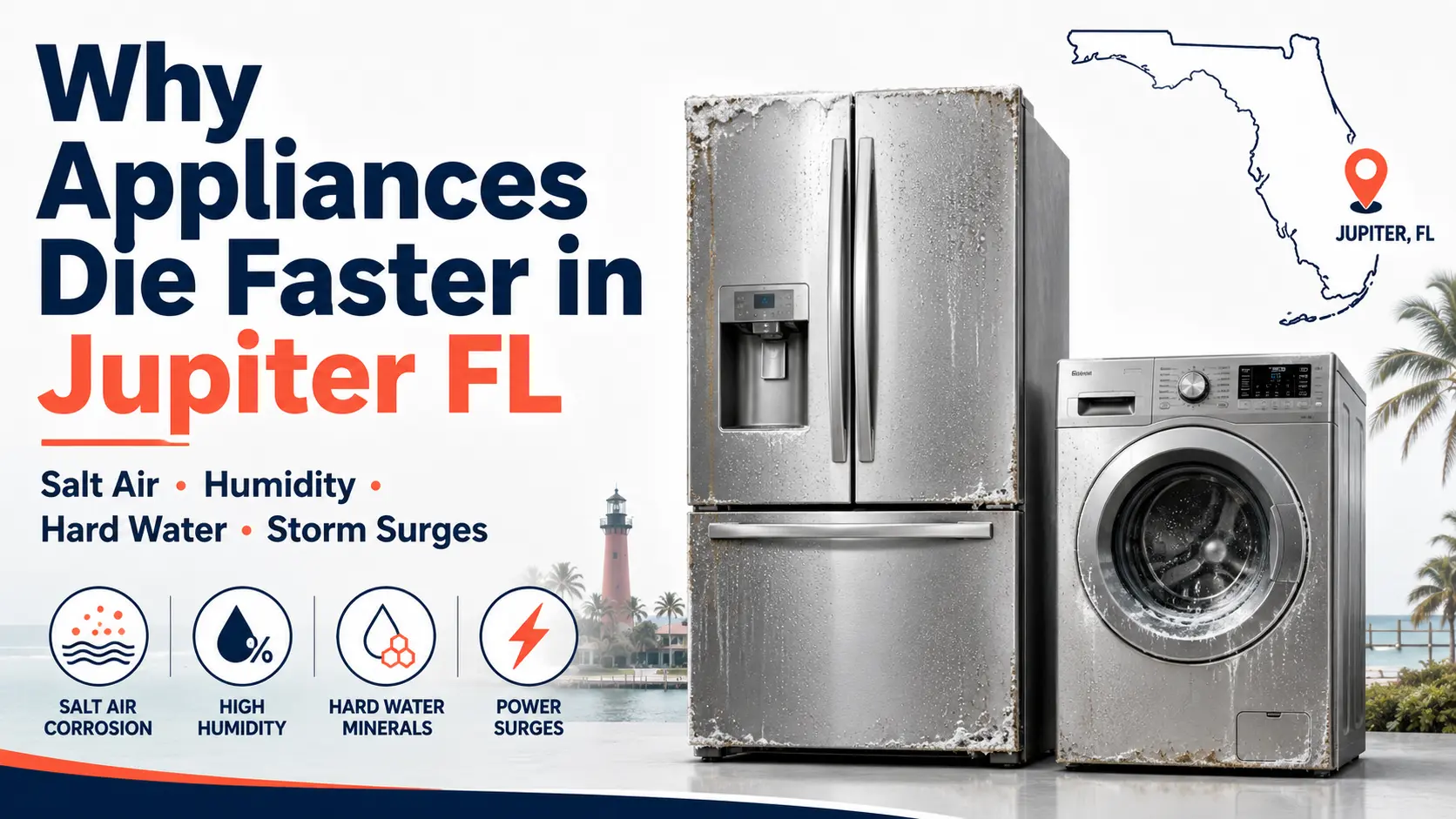
Most appliances in Jupiter FL die younger than the box says they should. The national averages that get cited everywhere — 13 years for a refrigerator, 11 years for a washer, 10 years for a dryer — those numbers came from manufacturer testing in controlled lab conditions. Not from salt air, not from 90-degree summers, and definitely not from Palm Beach County water that runs hard enough to leave mineral rings in a brand-new sink. In this climate, you’re looking at 20 to 35 percent shorter lifespans across the board if maintenance isn’t a regular thing in your house.
That’s the short answer. But the more useful thing to understand is why, because once you know the specific reasons appliances age faster in Jupiter FL, you can actually do something about some of them. A few of the biggest lifespan killers in coastal homes here are things a homeowner can address in an afternoon. Others are just the cost of living close to the water. Knowing the difference saves you from replacing things earlier than you need to — and from holding on to machines that have already started costing you more than they’re worth.
WHAT THIS POST COVERS
- Appliances in Jupiter FL typically last 20 to 35 percent less than the figures manufacturers publish. Salt air, humidity averaging 78 percent year-round, and hard municipal water are all working against the same machines simultaneously.
- The lifespan killers vary by appliance. Refrigerators lose years to coil corrosion and compressor strain. Washers and dishwashers take damage from mineral buildup in the water lines and pump assemblies. Dryers hold up better but still run harder than they’re designed to in the heat.
- Storm season, June through November, brings power surges that can take out a control board or compressor in a fraction of a second. A single bad surge from a fast-moving afternoon storm can strip years off an appliance that had plenty of life left.
- The repair-versus-replace calculation looks different in a coastal Florida climate than it does anywhere else. An 8-year-old refrigerator that would be worth repairing in most cities might not make financial sense near Jupiter Inlet.
- There are specific maintenance habits that genuinely extend appliance life in this climate. Most of them take less than 30 minutes a month.
What the “Standard” Lifespan Numbers Actually Mean — And Why Florida Changes Them
The appliance lifespan figures you see everywhere — from Department of Energy publications to the back of the warranty card — are based on manufacturer testing in controlled conditions. Average humidity. Stable power. Clean water with minimal mineral content. None of those conditions apply in Jupiter FL, and that gap matters more than most people realize.
When a manufacturer says a refrigerator lasts 13 years, they’re describing performance in an environment with roughly 50 percent relative humidity, consistent incoming voltage, and water that won’t deposit calcium on anything it touches. In Jupiter, summer humidity regularly sits between 80 and 85 percent. The municipal water supply runs between 180 and 250 parts per million in mineral hardness. And FPL delivers power through a grid that gets hit hard during a storm season that runs half the year. Those conditions aren’t anywhere close to the test lab.
This isn’t really the manufacturer’s fault. They’re testing to a standard. The standard just wasn’t designed for coastal South Florida.
The other thing worth understanding is what “lifespan” actually means. It doesn’t mean the appliance runs perfectly and then dies one day. It means the point at which energy inefficiency and repair costs make keeping the machine a bad financial decision. An appliance that’s technically still running at 13 years in Jupiter FL might be consuming 25 percent more electricity than it should and sitting one bad day away from a $500 compressor repair. That’s not really a functioning appliance anymore. That’s a liability you’re still feeding money into.
Sandra M. in Tequesta called in the fall of 2024 about her Whirlpool side-by-side, which she believed was running fine at 10 years old. When the tech got into it, the condenser coils were caked in a mix of dust, humidity residue, and mineral coating so thick the unit was effectively running hot all day. The compressor was already showing stress. She had the machine serviced and cleaned, which bought her another 18 months, but the tech told her straight: at 10 years in a Tequesta home, she was probably making a replacement decision within two years. She appreciated knowing that before the machine made the decision for her.
If you’re not sure whether what you’re seeing is a normal service issue or a bigger warning sign, check what your appliance is doing before calling anyone out.
What Salt Air Is Actually Doing Inside Your Appliances
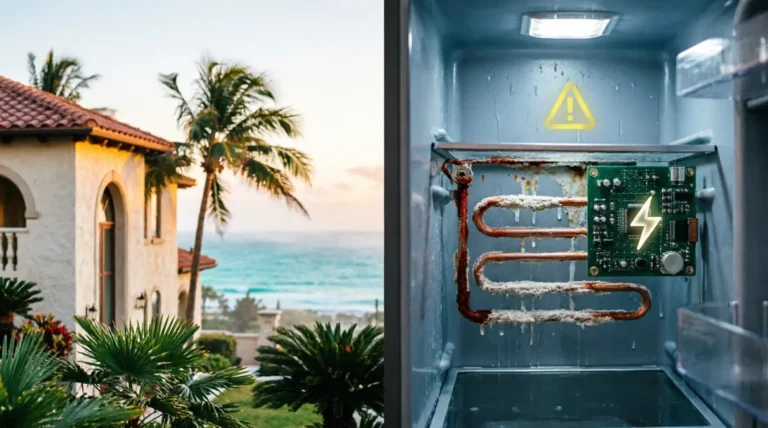
Salt air doesn’t just rust the outside of things. The sodium chloride particles that travel in off the Atlantic and the Intracoastal Waterway get pulled into your appliances every time they cycle air. They corrode internal electrical connections, coil surfaces, and the metal brackets holding components together — from the inside. Homes within a mile of Jupiter Inlet take the hardest hit, but nowhere in Jupiter FL is far enough inland to fully escape it.
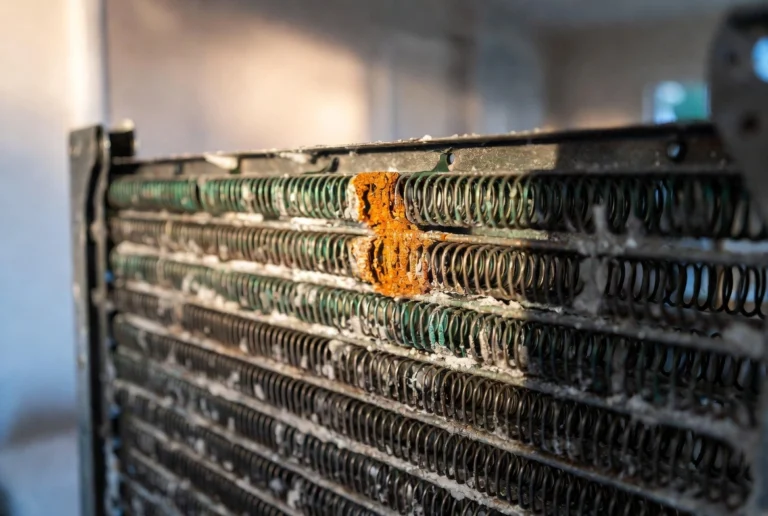
The damage is slow and quiet. Over two or three years, salt deposits build up on the condenser coils of your refrigerator, on the heating element connections in your dryer, and on the circuit board terminals inside your washer. The machine keeps running. It just works harder than it should. Then one day it doesn’t work at all, and it feels sudden — but the actual deterioration started years earlier.
For refrigerators, salt air corrosion on the condenser coils is one of the most common reasons units in coastal Jupiter FL homes die younger than their inland counterparts. Corroded coils can’t release heat the way they’re supposed to, so the compressor compensates by running longer and hotter. A compressor running past its design limits through a Jupiter summer doesn’t have the full lifespan the manufacturer assumed.
There’s a lot more to this than most people expect. The post covering what salt air does inside your appliances goes into the specific failure patterns by appliance type if you want the full picture.
Patricia W. had a six-year-old LG front-load dryer on the canal side of Tequesta that started throwing a heating error in March 2025. The machine itself was in decent shape. When the tech opened it up, the heating element terminals had corroded badly enough that they weren’t making solid contact anymore. It was a $185 repair, not a replacement situation. While he was in there, the tech cleaned the other exposed metal connections and applied a protective coating to them. That kind of step makes a real difference in a salt-air environment and didn’t add much to the bill.
The Real Lifespan Numbers for Appliances in Jupiter FL Homes
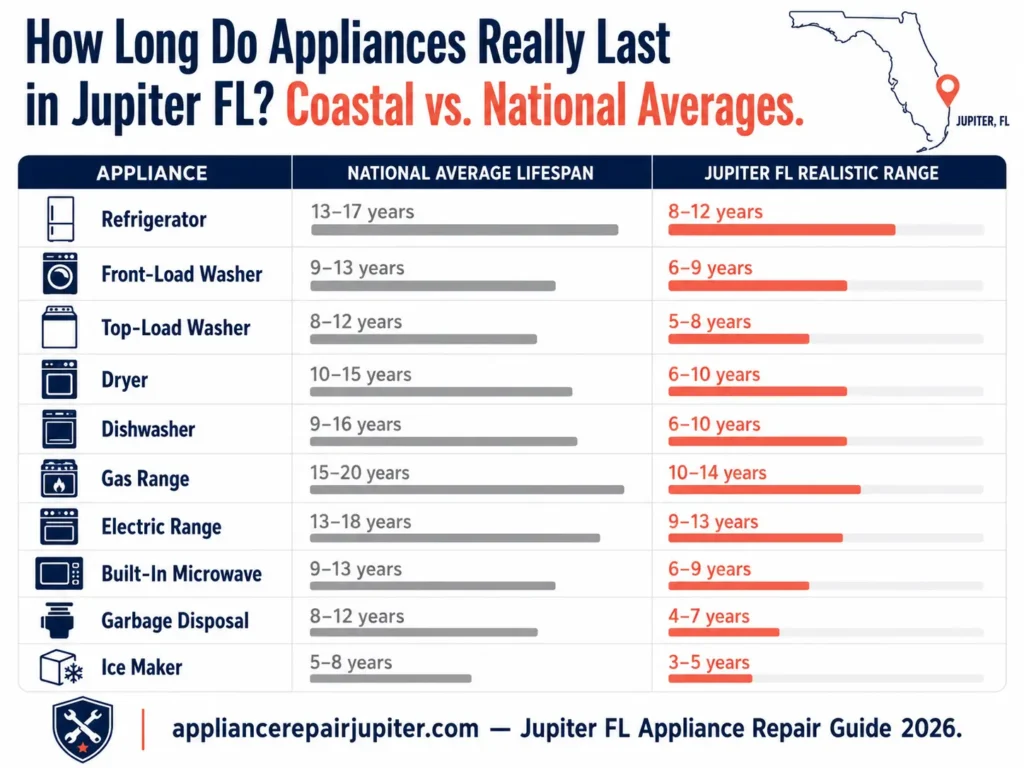
Here’s what you should actually plan around if you’re in Jupiter FL. These estimates account for coastal humidity, Palm Beach County water quality, and the thermal load your appliances carry through a South Florida summer. They’re not worst-case numbers. They’re realistic averages for appliances that are being reasonably maintained.
| Appliance | National Average | Jupiter FL Realistic Range |
|---|---|---|
| Refrigerator | 13 years | 9 to 11 years |
| Front-load washer | 10 to 11 years | 7 to 9 years |
| Top-load washer | 10 years | 8 to 10 years |
| Dryer (gas or electric) | 13 years | 10 to 12 years |
| Dishwasher | 9 years | 6 to 8 years |
| Gas range / oven | 15 years | 12 to 15 years |
| Electric range / oven | 13 years | 10 to 13 years |
| Built-in microwave | 9 years | 7 to 9 years |
| Garbage disposal | 12 years | 8 to 10 years |
| Built-in ice maker | 5 to 7 years | 4 to 6 years |
A few things worth noting. Dryers hold up relatively well compared to other appliances because they don’t deal with water input or refrigerant. Gas ranges are surprisingly durable even in coastal conditions because there’s not much for salt air to corrode at the combustion level. Ice makers are a different story entirely. The combination of hard water mineral deposits in the water lines and constant humidity-driven condensation cycles makes them one of the fastest-failing components in any Jupiter FL kitchen.
If ice maker issues in coastal homes are already showing up, that’s worth addressing sooner rather than later. Left alone, ice maker problems can cascade into water line damage and eventually a larger refrigerator issue.
What Hard Water Is Quietly Doing to Your Washer and Dishwasher
Palm Beach County’s water runs hard. Depending on where in Jupiter you are, you’re pulling water between 180 and 250 parts per million in dissolved minerals, mostly calcium and magnesium. For your washer and dishwasher, that mineral load means scale buildup inside hoses, on heating elements, and inside pump assemblies — and it happens faster than you’d expect.
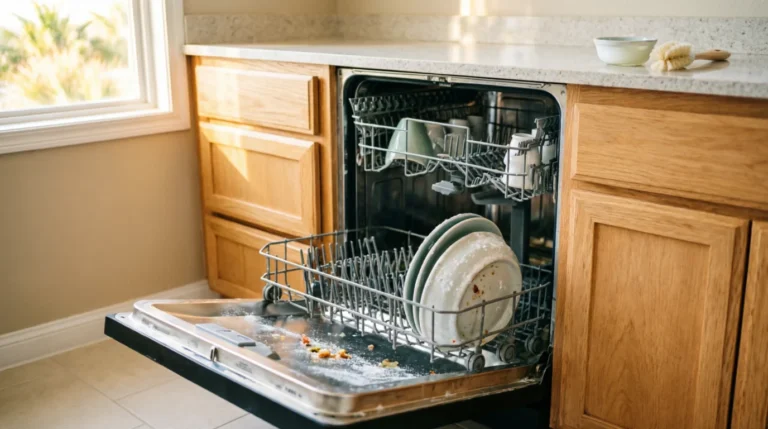
The visible signs come first in the dishwasher: cloudy glasses, a white film on dishes, residue that won’t wash off no matter how much detergent you use. What you’re not seeing is that same scale building up on the heating element inside the machine. Once the element is coated in mineral deposits, it runs hotter than it should to compensate. Over a couple of years, that shaves significant life off the element and puts stress on the control board as well.
In washers, hard water affects the inner drum, the water inlet valve, and the drain pump. The buildup restricts water flow gradually and puts stress on the pump motor over time. Front-loaders deal with this a bit differently than top-loaders because water sits in the drum longer per cycle, giving minerals more opportunity to deposit on surfaces. If you’re in a part of Jupiter Farms that pulls from a private well rather than municipal supply, the mineral content could be even higher depending on what’s in the local groundwater.
Running a washer cleaning cycle with a citric acid or descaling product once a month makes a meaningful difference. Leaving the washer door open between cycles helps too, which also addresses the mold issue that front-loaders in this humidity are almost guaranteed to develop. The maintenance schedule tool builds this out appliance by appliance if you want something you can actually stick to.
The Garcias in Abacoa reached out in January 2025 about their dishwasher leaving a white film on everything. The machine was seven years old, right at the edge of what’s realistic in Jupiter FL. The heating element had significant calcium scale buildup, and the spray arms were partially blocked with mineral deposits. They had it serviced for $145, which cleared the problem. The tech was straight with them though — the control board was also showing its age. They got another good year out of it and then replaced it on their own schedule rather than as an emergency.
Summer Heat, Storm Season, and What Power Surges Do to Your Appliances
Every summer in Jupiter FL, from June through November, your appliances run harder and at higher risk than they do the rest of the year. Ambient temperatures pushing into the low 90s force refrigerators and freezers to work 15 to 20 percent harder than manufacturers design them to. Every afternoon thunderstorm that builds over Palm Beach County brings with it a real chance of a voltage spike that can kill a control board or compressor in a fraction of a second.
The heat piece is straightforward. When a garage or kitchen without good ventilation climbs above 90 degrees, a refrigerator’s compressor is fighting hard just to hold 37 degrees inside. That kind of sustained thermal stress compresses the compressor’s functional lifespan. A unit that might have lasted 11 years in a more temperate environment can struggle to reach nine when it spends every Florida summer running near its limits.
Power surges are the other issue. FPL does solid work maintaining the grid, but the fast-moving convective storms that build over South Florida in summer can cause voltage fluctuations that hit electronics hard. The most vulnerable components are control boards — the circuit that manages your appliance’s cycles and sensors. A control board replacement runs $180 to $280 on most appliances. That’s a real risk every storm season if you’re not using surge protection on your higher-value units.
Whole-home surge protection at the electrical panel is the best option. Appliance-level surge protectors are worth using for refrigerators, washers, and dryers at minimum. It’s one of the few genuinely cheap insurance policies available to a Jupiter FL homeowner.
After a strong storm cell moved through the Jupiter Farms area in August 2024, Mike D. found his Samsung side-by-side had stopped making ice and was running noticeably warmer than usual. The main control board had taken a surge hit. The compressor survived, which was the good news. The repair came in at $310. If the compressor had been damaged too, that would have been a replacement conversation on a seven-year-old machine. Samsung appliance calls after storms follow a predictable pattern in this area, and control board failures after surge events are near the top of the list.
The Signs That Tell You an Appliance Is Getting Close to the End
Most appliances don’t just fail suddenly. They usually give you weeks or months of warning if you know what to watch for. Catching these signs early means making the replacement decision on your schedule, not on the worst possible day.
Refrigerator: The compressor runs constantly without cycling off. You can hear it clearly from another room. There’s pooling water inside or beneath the unit. The back wall of the freezer section has heavy frost buildup. The food in the fridge section is running a degree or two warmer than the set temperature, even after the settings haven’t changed. Any of these, especially in combination, is a signal worth taking seriously.
Washer: Cycles take noticeably longer than they used to. There are grinding or banging sounds during the spin. Clothes come out significantly wetter than normal after the spin cycle completes. The machine stops mid-cycle repeatedly. And in Jupiter FL specifically: a persistent mildew smell in the drum even after cleaning cycles is a sign that the gasket seals and drum surfaces have deteriorated past the point where maintenance alone will fix it.
Dryer: It’s taking two cycles to fully dry a normal load. The outside of the cabinet feels hot to the touch near the top. Heat output is inconsistent from one cycle to the next. These are almost always signs of a restricted vent duct, a failing heating element, or both.
Dishwasher: Food residue on dishes after a full cycle. Water sitting in the bottom when the cycle ends. A cracked or lifting door seal. Grinding from the pump during the wash cycle. At five years old in a Palm Beach County home, a dishwasher showing any of these is probably closer to replacement than most owners expect.
If the refrigerator is no longer keeping food cold, that particular symptom is one of the more urgent situations because the diagnosis completely changes the conversation about whether it’s worth repairing at all.
Rachel K. in PGA National noticed her five-year-old Bosch dishwasher running louder than usual in the fall of 2024. She ran it through a few more cycles before calling. By the time a tech came out, the wash pump motor had partially seized and damaged the lower spray arm in the process. The repair ran $265. If she’d called at the first noise, it likely would have been a $130 pump repair before the arm got damaged. The machine had plenty of life left — the catch was just waiting one week too long.
How to Think About Repair Versus Replace in Jupiter FL
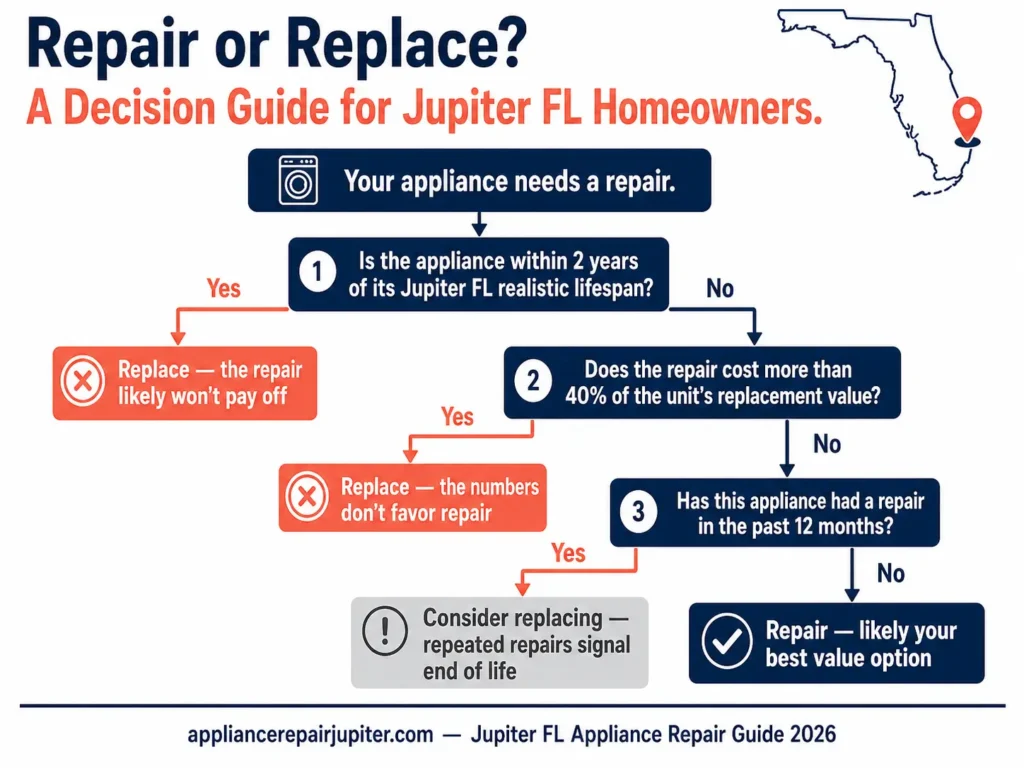
The standard rule for appliance repair decisions is that if a repair costs more than 50 percent of the appliance’s replacement value, you replace it. That rule works in most parts of the country. In Jupiter FL, I’d lower that threshold to 40 percent, because a coastal climate means you’re not getting the remaining lifespan out of the repaired unit that the rule assumes.
Here’s the logic. Say you have a nine-year-old refrigerator in a Jupiter FL home near the water and it needs a $450 compressor repair. A comparable new unit runs $1,800. The standard 50 percent rule suggests the repair is worth it. But a refrigerator that’s already nine years old in a coastal environment has maybe two to four realistic years of useful life remaining. That $450 repair works out to $112 to $225 per year of remaining life in the best case. A new unit at $1,800 gives you nine to ten years at roughly $180 to $200 per year. In a climate-neutral environment, those numbers are closer. In Jupiter FL, the math shifts toward replacement sooner.
The age of the appliance matters most in this calculation. If a unit is within two years of its realistic Jupiter FL lifespan, almost any significant repair is hard to justify. If it has four or more years of realistic life remaining and the repair costs less than 40 percent of replacement value, repair usually makes sense.
Before committing to either side of that decision, run the numbers first with your specific appliance age, repair quote, and replacement cost. It takes a couple of minutes and can save you from a choice you’ll regret in either direction.
Tom B. in Juno Beach called about his 11-year-old GE top-load washer in February 2025. It needed a new transmission, which was going to cost $380 to $420 in parts and labor. A comparable new washer was quoted at $600. At 11 years old, right at the upper end of what’s realistic for a washer in Jupiter FL conditions, the repair would have cost 63 to 70 percent of replacement cost. He replaced it. The tech walked him through why, including the remaining lifespan math, and he appreciated the honesty even though it wasn’t the cheaper answer that week. GE appliance work in this market turns up transmission issues on older top-loaders regularly, and it’s one of those situations where age and cost have to be looked at together.
Which Brands Hold Up Better in Coastal Florida Conditions
No brand was designed specifically for South Florida coastal environments. But there are real differences in how different manufacturers handle sustained humidity, heat, and the voltage fluctuations that come with living in hurricane country.
Whirlpool and Maytag tend to sit at the more durable end of what we see locally. Their internal component layouts give salt air and moisture fewer places to collect, and they’re generally built for straightforward serviceability. Not flashy machines, but they run a long time with consistent maintenance. Whirlpool units we service locally consistently show up in the longer-lifespan end of the range.
LG makes excellent machines with solid efficiency ratings, but their refrigerators had a documented compressor failure issue in units produced roughly between 2016 and 2021. If you have a linear compressor LG fridge from that era, it’s worth knowing about that. The newer models have improved on this considerably. The LG fridges we see regularly now are holding up better than those mid-generation units were.
Samsung ice makers are a consistent problem in high-humidity environments, and this isn’t a controversial position among techs who work in South Florida. The ice maker design in many Samsung models struggles with the humidity-driven freeze-thaw cycles that happen constantly in a coastal Florida kitchen. If you’re buying a Samsung refrigerator in Jupiter FL, plan for an ice maker service call within the first five years.
Bosch dishwashers hold up notably well in hard water conditions because of how they manage water temperature and cycle length. They’re worth the higher upfront cost in Palm Beach County if the dishwasher is an appliance you actually rely on. Bosch on the dishwasher side tends to outlast most competitors specifically in this area, and the repair frequency we see reflects that.
KitchenAid and Frigidaire both perform adequately in coastal conditions. Neither stands out dramatically in either direction based on what we see across Jupiter FL and the surrounding communities.
How to Get More Years Out of Every Appliance You Have
The single highest-return maintenance task in any Jupiter FL home is cleaning the refrigerator condenser coils every four to six months. This one thing alone can add two to three years to a refrigerator’s working life in coastal conditions. Everything else matters, but nothing else matters as much as this.
The coils are usually behind a kick plate at the bottom front of the refrigerator, or on the back of older units. Unplug the machine, pull the cover, and use a coil brush or vacuum with a narrow attachment to clear the buildup. In a Jupiter FL home with even normal dust and any pets in the house, the coils coat over fast. This is the step most people skip, and it’s the one that costs them.
Beyond that, a few habits make a real difference:
Clean the dryer vent duct all the way to the exterior wall once a year, not just the lint trap on the inside. The duct is where the real efficiency loss and fire risk accumulate. A partially clogged vent makes the dryer run hotter, work harder, and burn through its heating element faster.
Run a descaling cycle on the washer every month. In Palm Beach County’s hard water, front-loaders especially need this. Leaving the washer door open between cycles also limits the mold buildup that is essentially inevitable for front-loaders in this humidity.
Check door gaskets on the refrigerator and dishwasher quarterly. In Jupiter FL heat and humidity, gaskets dry out and crack faster than they would anywhere cooler. A cracked refrigerator door gasket forces the compressor to run almost continuously.
Install surge protection on your refrigerator, washer, and dryer. The storm surge risk in this area is real and it doesn’t only come from named hurricanes. The fast-moving afternoon convective storms in July and August are responsible for more appliance control board failures than most people would guess.
For a month-by-month plan for your specific appliances built around South Florida conditions, the maintenance checklist generator walks through every machine in the house. If something is already showing a symptom, use the error code decoder to decode what the machine is telling you before a tech comes out — it often gives you a head start on the conversation.
Frequently Asked Questions
How long should a refrigerator last in Jupiter FL?
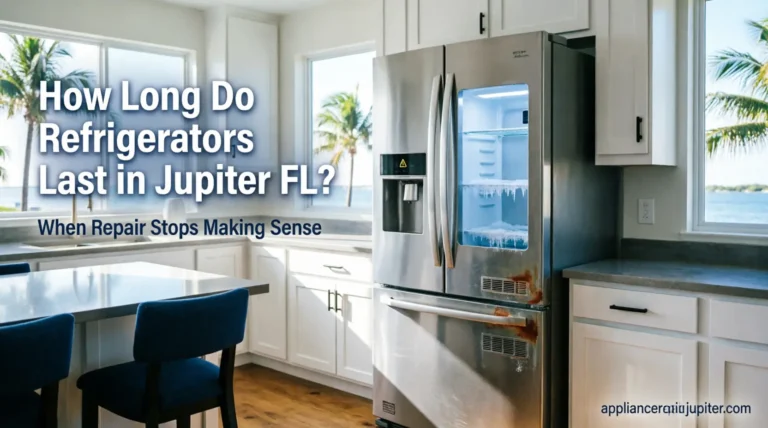
A well-maintained refrigerator in Jupiter FL realistically lasts 9 to 11 years. The national average of 13 years doesn’t account for salt air corrosion, the thermal stress of running through South Florida summers, or the effect of Palm Beach County’s hard water on water line components. Units within a mile of Jupiter Inlet or the Intracoastal tend to trend toward the lower end of that range.
Do appliances actually wear out faster near the ocean in Florida?
Yes, and the difference is meaningful. Salt air corrosion, sustained humidity above 78 percent, and hard municipal water all affect appliance components simultaneously. Homes within half a mile of Jupiter Beach or the waterway see the most accelerated wear, but the effect extends across the entire Jupiter FL area regardless of how close you are to the water.
How long does a washing machine last in Jupiter FL?
Front-loaders in Jupiter FL typically last 7 to 9 years. Top-loaders hold up a bit better at 8 to 10 years. Hard water mineral buildup in the pump and hoses is the main lifespan limiter for both types. Regular descaling maintenance can push either toward the longer end of those ranges. On the washer repair side, the most common failures we see are pump motor burnout and drum bearing wear, both of which are accelerated by mineral deposits.
Is it worth repairing a 10-year-old refrigerator in Jupiter FL?
Rarely, if the repair is significant. At 10 years in a Jupiter FL coastal home, a refrigerator is already at or past the midpoint of its realistic remaining life. If the repair quote is above $300, the math usually doesn’t favor it. Minor repairs like a door gasket or thermostat can still make sense at that age, but anything involving the compressor or sealed system is a hard case to make on a decade-old coastal unit.
What does Palm Beach County hard water actually do to appliances?
With mineral content running between 180 and 250 ppm, Palm Beach County water deposits calcium and magnesium scale inside washing machine hoses, on dishwasher heating elements, in refrigerator water line fittings, and inside garbage disposals. The scale reduces efficiency, strains pumps and motors, and physically shortens the lifespan of any appliance that handles water regularly.
How often do appliances fail during hurricane season in Jupiter FL?
Storm-related appliance failures spike significantly from June through November. The most common cause isn’t named hurricanes — it’s the fast-moving afternoon thunderstorms in July and August that cause the most voltage fluctuations. Control boards and compressors are the most commonly damaged components. Whole-home surge protection at the panel and individual surge protectors on major appliances reduce this risk substantially.
How long do dryers last in Jupiter FL?
Gas and electric dryers typically hold up for 10 to 12 years in Jupiter FL, making them among the more durable appliances in a coastal climate. They don’t handle water or refrigerant, which removes the two biggest lifespan stressors. Annual vent cleaning is the maintenance step that matters most. Dryer-specific repairs in this area are most often heat-related rather than mechanical — heating elements and thermal fuses are the common failures.
Should I get whole-home surge protection in Jupiter FL?
Yes, and most people who’ve had a storm-related appliance failure wish they’d done it sooner. Jupiter FL sits in one of the most active lightning and convective storm zones in the country during summer months. The cost of a whole-home surge protector installed at the panel typically runs $250 to $400 all in. One control board replacement on a refrigerator runs $180 to $280 by itself. The math is straightforward.
How long do dishwashers last in Jupiter FL homes?
Dishwashers in Jupiter FL average 6 to 8 years, which makes them one of the shorter-lived major appliances in coastal homes. Palm Beach County’s hard water is the primary culprit, building mineral scale on heating elements and blocking spray arms over time. Running a dishwasher descaler monthly and using rinse aid consistently extends life toward the higher end of that range. Dishwasher work in Jupiter breaks down with mineral-related failures more than any other single cause.
What’s the repair-versus-replace rule, and does it change for Jupiter FL?
The standard rule is: don’t repair if the repair costs more than 50 percent of the appliance’s replacement value. In Jupiter FL, a more realistic threshold is 40 percent, because shorter coastal lifespans mean you get fewer remaining years from a repaired older unit than the standard rule assumes. The math changes once you account for what the climate does to remaining useful life.
Which appliances break down most often in Jupiter FL homes?
Ice makers, dishwashers, and refrigerators generate the most repair calls in this area. Ice makers deal with the combined stress of hard water deposits and constant humidity-driven condensation cycles. Dishwashers suffer from the water hardness directly. Refrigerators work harder in the summer heat and take coil corrosion from the salt air. Dryers and gas ranges tend to be the most reliable in a coastal Florida climate.
How do appliance lifespans compare between Abacoa and homes near the water?
Homes closest to the Jupiter Inlet, Jupiter Beach, and the Intracoastal deal with higher salt air concentration, which is the most aggressive factor for internal component corrosion. Homes in Abacoa are far enough inland to reduce the salt air effect somewhat. The hard water and humidity are effectively the same across the service area, so the lifespan difference is real but not dramatic — typically one to two years on average for appliances that are otherwise equally maintained.
Are there specific things I should do to protect appliances during hurricane season?
Surge protection is the most important step — either whole-home at the panel or at least individual protectors on the refrigerator, washer, and dryer. If you lose power for more than a few hours, resist opening the refrigerator and freezer unnecessarily. After power returns, give the refrigerator 30 minutes to restabilize before loading it back up. Freezer issues after storms often involve compressor stress from the recovery cycle rather than direct surge damage, and letting the unit stabilize before stressing it helps.
How do I know if a repair is genuinely worth it for my specific appliance?
The best starting point is the appliance age relative to its realistic Jupiter FL lifespan, combined with the repair cost as a percentage of replacement value. Our team has been doing this in Jupiter for over a decade and can give you a straight answer on whether what you’re dealing with is worth fixing. No pressure in either direction — if replacement makes more sense, we’ll tell you that.
Wrapping This Up
If you’re reading this because something in your house is already acting up, that’s a stressful spot to be — especially in a Jupiter FL summer when an appliance failure doesn’t wait for a convenient time. The main thing to take away is that the timeline rules are genuinely different here, and knowing that upfront helps you make better decisions before you’re standing in front of a repair quote with no context.
The appliance symptom diagnostic tool is a solid first step if you’re trying to figure out whether what you’re seeing is a minor service issue or the start of something bigger. The cost tool helps you run the repair-versus-replace math for your specific situation before committing either way.
When you’re ready to have someone come take a look, get connected with a local tech who works in this area. Someone who knows what the climate here actually does to machines.
2 Comments