
What Jupiter FL Appliance Repair Techs Actually Find Inside Coastal Homes (And What It Means for You)
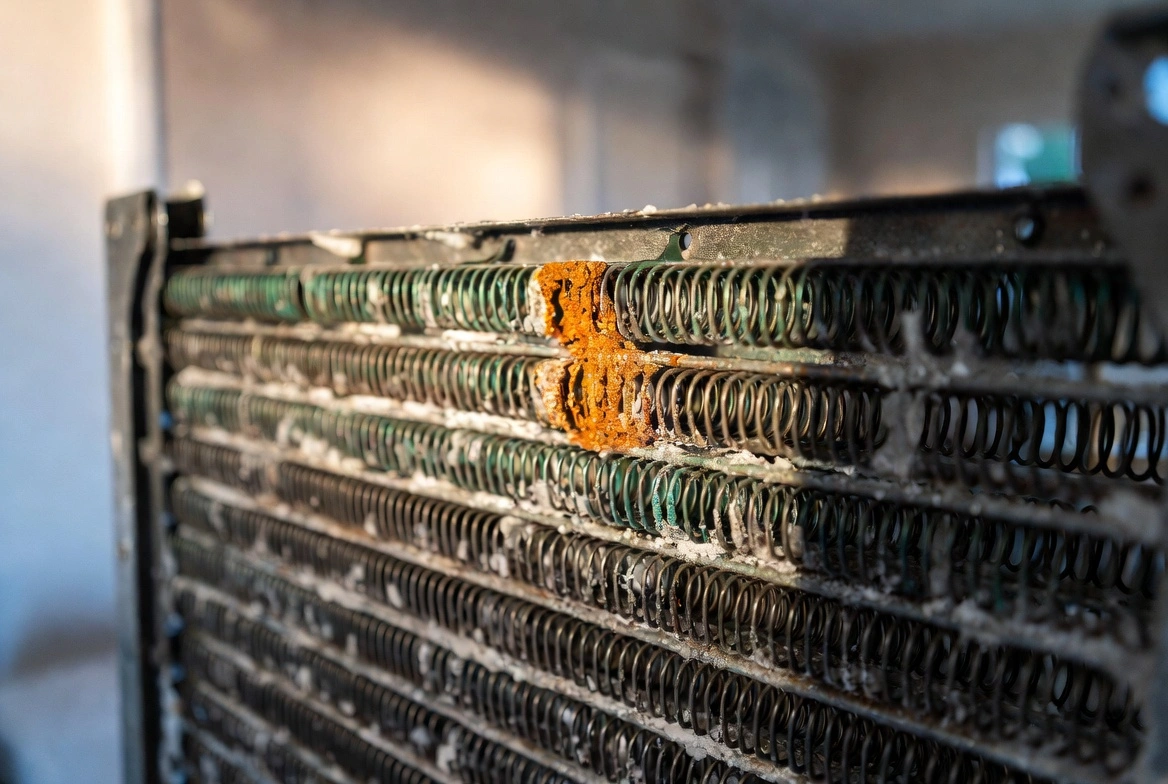
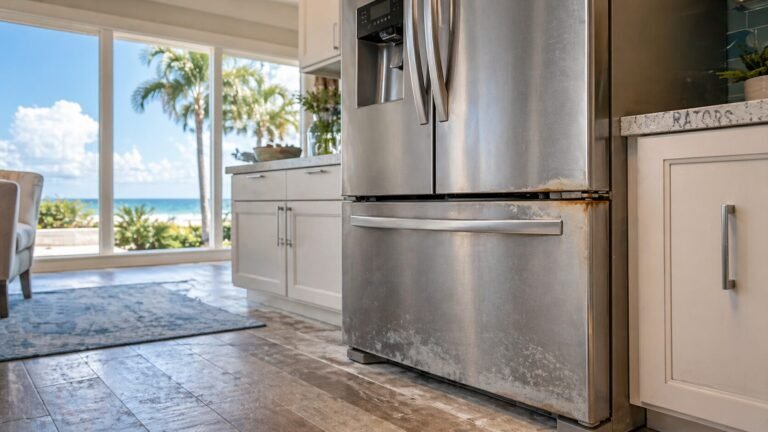
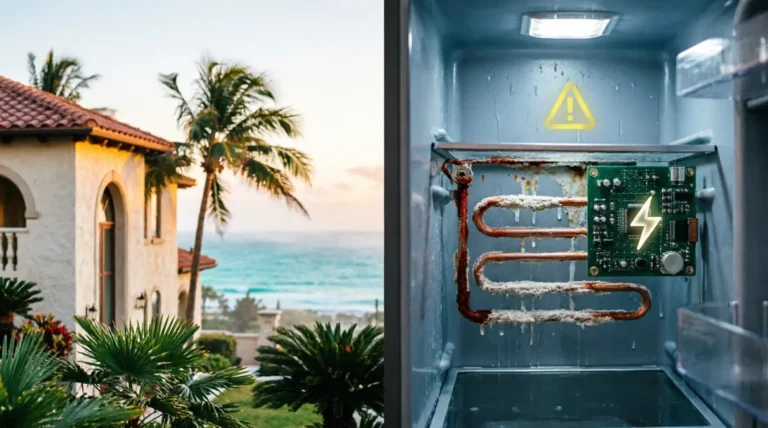
Salt air and humidity in Jupiter FL do damage to appliances that most homeowners never see coming, because the damage happens on the inside. The outside of your refrigerator looks fine. But open the back panel and you might find corrosion on the condenser coils, rust on the compressor housing, and a film on the control board that no one told you to worry about.
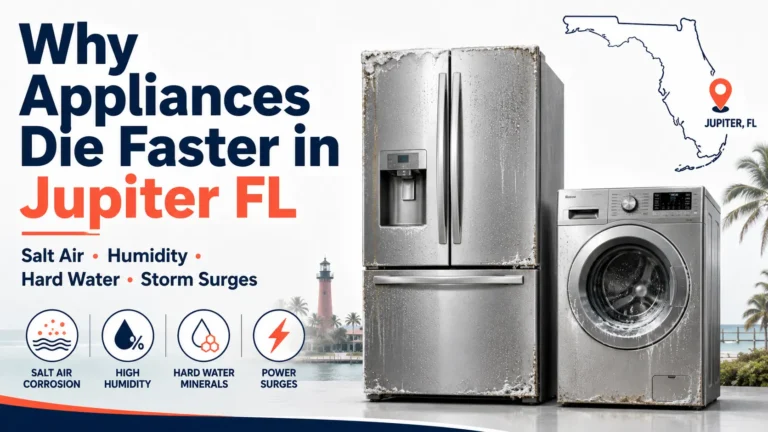
Machines that would last 14 or 15 years in a dry inland climate are done in 8 or 9 here. That is not a scare tactic. It is just what happens when you mix 78 percent average humidity, Atlantic salt air, and Palm Beach County hard water with machines that were tested in controlled factory conditions nowhere near the coast.
This post goes through what actually shows up when a tech opens a machine in Jupiter, Tequesta, Juno Beach, and the surrounding area. What it looks like. What it costs. And what you can do about it before you get the call you do not want to get.
What This Post Covers
- Salt air reaches the inside of sealed appliances through door gaps, ventilation openings, and utility line penetrations. No appliance is truly airtight.
- Control boards are the most expensive casualty of coastal humidity in Jupiter FL. A single corroded circuit board can cost $200 to $600 to replace, and in some machines that repair is not worth doing if the unit is already older.
- Refrigerators, dishwashers, and washing machines take the worst of it first in coastal homes, followed closely by dryers and range hoods near the water.
- Palm Beach County municipal water tests between 180 and 250 parts per million of mineral hardness. That load does specific damage to dishwashers, water lines, and washing machine drums that is completely separate from the salt air problem.
- Most of the damage is slow and invisible for years. By the time a symptom shows up, the corrosion underneath has usually been building for a long time.
How Does Salt Air Actually Get Inside a Sealed Appliance?
Salt air gets into appliances through door seals, ventilation slots, and the openings where water lines and electrical conduit pass through the back or bottom of the unit. No household appliance is fully sealed against the environment. If air can move around and through your home, it can reach the inside of your machines.
That might be surprising. People picture their refrigerator as a closed box. But look at the back. There are ventilation grilles, gaps around the compressor housing, and slots where the power cord exits the cabinet. All of that is open to whatever is in the air around it.
In homes within half a mile of the Jupiter Inlet or the Intracoastal Waterway, the salt concentration in the air is measurably higher than in a neighborhood like Jupiter Farms, which sits further inland. Working on appliances in Tequesta canal homes and Juno Beach condos, you consistently find visible corrosion on metal components that would not be there on an inland machine of the same age. The difference is real and it shows up in the parts.
The process is called hygroscopic absorption. Salt particles in the air attract and hold moisture. When those particles land on metal surfaces inside an appliance, they pull ambient moisture to the surface and hold it there long enough to start oxidizing the metal. In Jupiter FL summers, where outdoor humidity regularly hits 85 percent or higher, that process speeds up considerably.
The first surfaces to corrode are usually unpainted steel components: the frames, brackets, and mounting hardware inside the cabinet. Then it moves to copper refrigerant lines and, eventually, to the electrical connections on the control board.
The salt air appliance damage page goes into more detail on which components corrode first by appliance type. If you already have a machine showing rust or unusual behavior, that breakdown is worth reading.
Case study: In March 2024, a homeowner in a Tequesta canal home called about a GE Profile dishwasher leaving residue on every load. When the tech pulled the machine and removed the back panel, the heating element bracket was almost completely corroded through and three wiring harness connectors had green oxidation on the pins. The unit was six years old. In an inland home, that machine probably had four or five years left in it. Total repair: $290 for the bracket, connectors, and labor. The homeowner had no idea anything was wrong until the residue showed up.
What the Humidity Is Doing to Your Control Boards
Humidity is the main reason control boards fail early in Jupiter FL appliances. Moisture gets into the board’s protective coating over time, corrodes the solder joints and copper traces, and eventually causes the board to short or fail to communicate with the sensors and motors it controls.
This is the expensive part. Control boards on modern appliances are not cheap. A refrigerator main board runs between $150 and $450 depending on the brand and model. A washer control board can be anywhere from $120 to $350. Add labor and you are looking at $250 to $600 for a repair that, in a drier climate, you probably would not have needed for another five years.
The frustrating thing about control board failures is that they rarely announce themselves clearly. You might get an error code, which you can look up using the appliance error code decoder to get a starting point. But sometimes the board just behaves erratically. A refrigerator that cycles on and off at odd intervals. A washer that stops mid-cycle for no clear reason. A dishwasher that randomly skips the dry cycle. All of these can trace back to a board that humidity has been quietly degrading for months.
LG refrigerators from the French door series have a known sensitivity to humidity around the main board area. That is not unfair to LG specifically — plenty of brands have this problem — but if you have an LG unit in Jupiter FL, the main board is worth checking before the warranty expires. Samsung’s control boards in their side-by-side and four-door models have had similar issues in this climate. Their ice maker assembly in particular is genuinely frustrating to work on in Florida humidity, and the failure rate in coastal homes is higher than the manufacturer’s national data would suggest.
Case study: Last August, a homeowner in an Abacoa townhome called about her Whirlpool front-load washer stopping at different points in every cycle. The error code was vague. Inside, the main control board had visible moisture staining and two burned solder points. The board was four years old. Replacement came to $340 total including labor. She had been running the machine daily for a family of four in a laundry closet with no exhaust ventilation, which was accelerating the humidity buildup inside the cabinet. That detail comes up in almost every control board job done in Jupiter FL townhomes and condos.
For Whirlpool machines specifically, the control board in the washer is usually accessible and the part is well-stocked, which helps keep the repair cost on the lower end.
The Appliance-by-Appliance Breakdown: What Corrodes First in Jupiter FL Homes
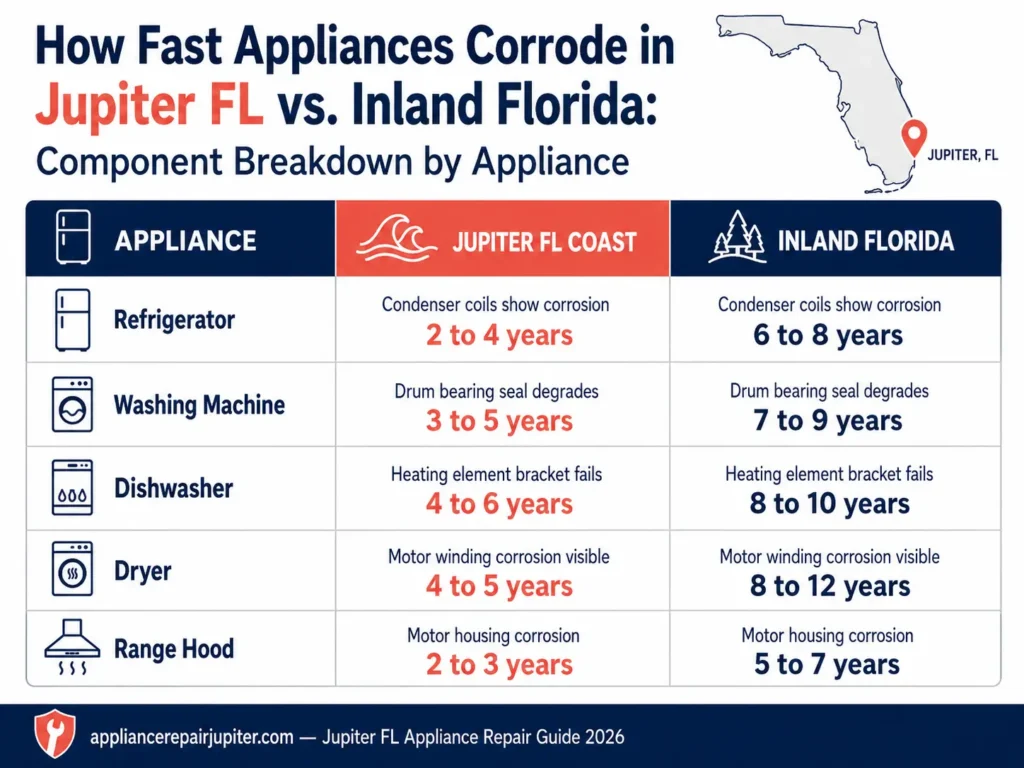
Every appliance in a coastal Florida home faces corrosion, but refrigerators, dishwashers, and washing machines take the worst of it first. The specific components that fail depend on the machine, but the pattern is consistent: anything unpainted, anything copper, and anything that sits in contact with moisture or humid air corrodes before anything else.
Here is what that looks like by machine:
Refrigerators. The condenser coils at the back or bottom of the unit are the first thing to go. Salt and dust combine on the coils and reduce heat transfer efficiency. The unit runs harder and longer to maintain temperature, which wears the compressor faster. In Jupiter FL homes, refrigerators that are working too hard often show this pattern before any obvious symptom appears. The ice maker assembly is the second casualty, particularly in Samsung and LG models with plastic water line connectors that crack under repeated thermal stress. The ice maker repair page covers the specific failure points in more detail.
Dishwashers. The heating element and its mounting bracket corrode in coastal homes faster than almost any other component in any appliance. The interior of a dishwasher is wet by design, and in hard water conditions like Palm Beach County’s 180 to 250 ppm supply, mineral scale builds up on the heating element and reduces its efficiency before the corrosion even has a chance to set in. The combination of mineral buildup and salt-humid air creates a situation where the machine is under pressure from two directions at once.
Washing machines. The drum bearing is usually the first finding. In front-load machines, the bearing is sealed but not permanently, and in high-humidity conditions the seal degrades faster than in dry climates. When the bearing starts to go, you hear a grinding noise during the spin cycle. By the time that noise is obvious, the bearing has usually been deteriorating for months. The washer repair page covers bearing sounds specifically, because it is one of the more common calls in this area.
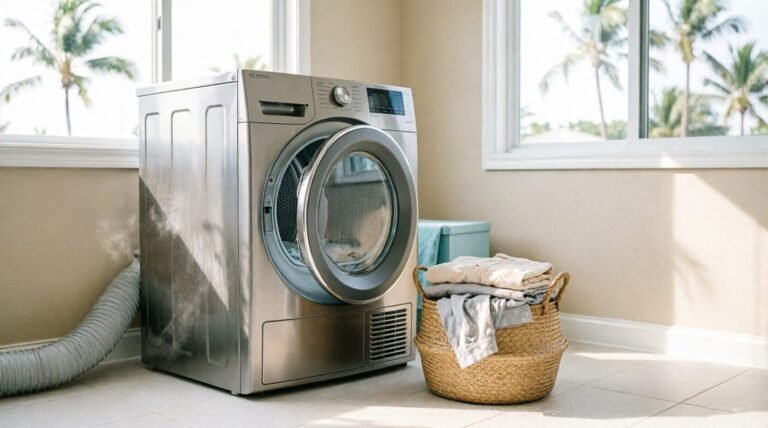
Dryers. The drum support rollers and the rear bearing plate both see accelerated wear in humid air. The motor windings on dryers in coastal homes show corrosion that would be unexpected on a unit only four or five years old. Dryers pulled from Juno Beach beachfront condos sometimes have motor housings that look like they have been running in a salt marsh.
Range hoods and vent hoods. These take it from both directions. Grease from cooking and salt air from outside meet in the vent housing and create a particularly corrosive environment for the motor and the aluminum grease filters. If you have not cleaned your range hood motor area in the last year, it is worth doing this week.
Hard Water Is the Other Problem Nobody Talks About
Palm Beach County municipal water tests between 180 and 250 parts per million of calcium and magnesium hardness. That is classified as very hard water. Over time, those minerals form scale on heating elements, inside water lines, on valve seats, and inside the drum of your washing machine. It is a separate problem from salt air, and it makes the salt air problem worse.
Scale on a heating element acts as an insulating layer. The element has to run hotter and longer to do the same job. That extra heat stress accelerates corrosion on every nearby metal component, including the control board connections that are already under pressure from humidity.
In dishwashers, the scale shows up first as white film on the interior walls and on glassware. Most people assume this is a detergent issue and switch products. But the detergent is not the root cause. The mineral content of the water is. A good quality rinse aid helps with the visible symptoms, but it does not stop the scale from building up on the heating element and the water inlet valve.
In washing machines, scale accumulates in the drum, on the water inlet valve filter screens, and around the detergent dispenser. Front-load machines are more vulnerable than top-loaders because they use less water per cycle, meaning the mineral concentration in that smaller volume is proportionally higher. The washer repair side of the site has more on scale-related symptoms if you are seeing buildup inside your drum.
In refrigerator water dispensers and ice makers, scale accumulates in the lines feeding the fill valve. This is one of the main reasons ice makers fail in Jupiter FL homes. The scale restricts flow to the valve, the valve has to work harder to open and close, and eventually it sticks or fails. If your ice maker is producing smaller cubes than usual, this is the first thing to check.
Case study: In November 2023, a homeowner in a PGA National estate called about her Bosch dishwasher not draining properly. The pump was fine. But the water inlet valve was almost completely blocked with calcium scale, and the heating element had deposits about three millimeters thick in places. Repair covered the inlet valve replacement, a descaling service, and cleaning the pump housing. Total cost: $275. She had been running the machine for four years without ever running a descaling cycle, which in Palm Beach County water is about two years too long.
If you want to understand how water quality varies across the area, the Palm Beach Gardens appliance repair page has some details on how mineral hardness differs across different parts of the county.
How Storm Season Makes Everything Worse
Hurricane season in South Florida runs June through November, and during that window, FPL power fluctuations during convective summer storms are a consistent appliance killer in Jupiter FL. Voltage spikes from lightning and grid switching events can damage control boards, compressor start capacitors, and motor windings in seconds, and the damage is not always obvious right away.
The storms that hit Jupiter hardest from an appliance standpoint are not usually the named hurricanes. It is the afternoon thunderstorms, which happen almost daily from June through September, that do the slow cumulative damage. A storm rolls through, the power flickers twice, the refrigerator restarts, and nothing seems wrong. But the capacitor on the compressor took a hit, and three months later the compressor does not start one morning.
Surge protectors help, but they are not magic. A good whole-home surge protector installed at the electrical panel gives appliances real protection against most events. Individual plug-in surge strips give almost no protection against a direct or near-direct lightning strike. If you have not talked to an electrician about panel-level surge protection for your Jupiter Farms or Abacoa home, that conversation is worth having before June arrives.
After major weather events, including power outages that come with named storms, refrigerators and chest freezers are the most immediate concern. A full refrigerator stays safe for about four hours without power. A full, unopened chest freezer can hold temperature for 24 to 48 hours. After an 18-hour outage, which is common after a significant storm passes through Palm Beach County, a refrigerator that was half-full when the power went out is in a gray area. The food may be borderline. The appliance itself may have taken surge damage when power was restored.
Case study: In September 2024, a homeowner in Jupiter Farms called two days after Tropical Storm Debby’s outer bands knocked power out for 22 hours. The refrigerator was cooling but running constantly. When the tech checked the unit, the start relay and capacitor on the compressor had been damaged by the power restoration surge. The compressor itself was fine. Parts and labor came to $185. If she had waited another two weeks, the compressor would have been running hot and the repair would have been significantly higher. More on refrigerator repair options here.
FPL provides guidance on surge protection on their website and it is worth reading if you have not looked at whole-home protection before.
What Techs Actually See When They Open the Back Panel
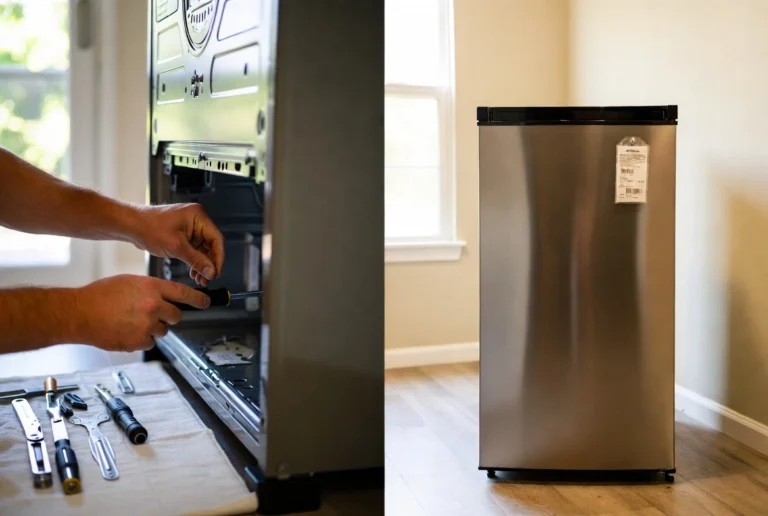
When a tech opens the back of an appliance in a Jupiter FL coastal home, the most common findings are dust and salt residue on condenser coils, corrosion on unpainted steel brackets, green oxidation on electrical connectors, scale buildup on water-contacting components, and occasionally, signs of a pest that found its way into the warm cabinet housing.
That last one is less rare than you might think, especially in Jupiter Farms and single-story ranch homes where utility rooms back up to vegetation.
The corrosion picture is what matters most. Here is what it looks like in practice.
Condenser coils that should be copper-colored are gray-green. The dust coating them is not just dust. In coastal homes, that coating contains salt particles and, in some cases, microscopic rust from nearby corroded components. Cleaning the coils helps, but if they have been coated for years, cleaning them reveals corrosion underneath that cleaning does not fix.
Control boards in high-humidity homes often have a faint moisture stain visible under the conformal coating that manufacturers apply to protect the board. When that coating fails, which happens faster in Jupiter FL conditions than the manufacturer’s testing accounts for, the copper traces start to corrode. By the time a symptom shows up, the board is usually not salvageable.
Wiring harness connectors are another consistent finding. The plastic connectors linking the main board to the sensors and motors throughout the machine develop green oxidation at the terminal pins. Cleaning them sometimes resolves an error code. Sometimes the oxidation has gone deep enough that the connector needs replacing.
The symptom diagnostic tool on the site can help you match what you are seeing or hearing to likely causes before a tech comes out. That gives you a better starting point for the conversation and sometimes saves a service call entirely.
Case study: In April 2024, a homeowner in a Juno Beach beachfront condo called about his Samsung four-door refrigerator making a grinding noise. The condo was on the third floor, about 80 yards from the beach. The tech found the evaporator fan motor blades were partially corroded and the blade had started contacting the housing at certain speeds. The unit was six years old. Fan motor replacement came to $220 for parts and labor. But the condenser coils were in bad enough shape that a cleaning and refrigerant line inspection was also recommended. Total visit: $310. He had noticed the noise for about three months before calling. In Samsung units specifically, catching the fan motor early matters because the evaporator assembly is not cheap if you let the problem run.
When to Repair, When to Walk Away, and How to Tell the Difference
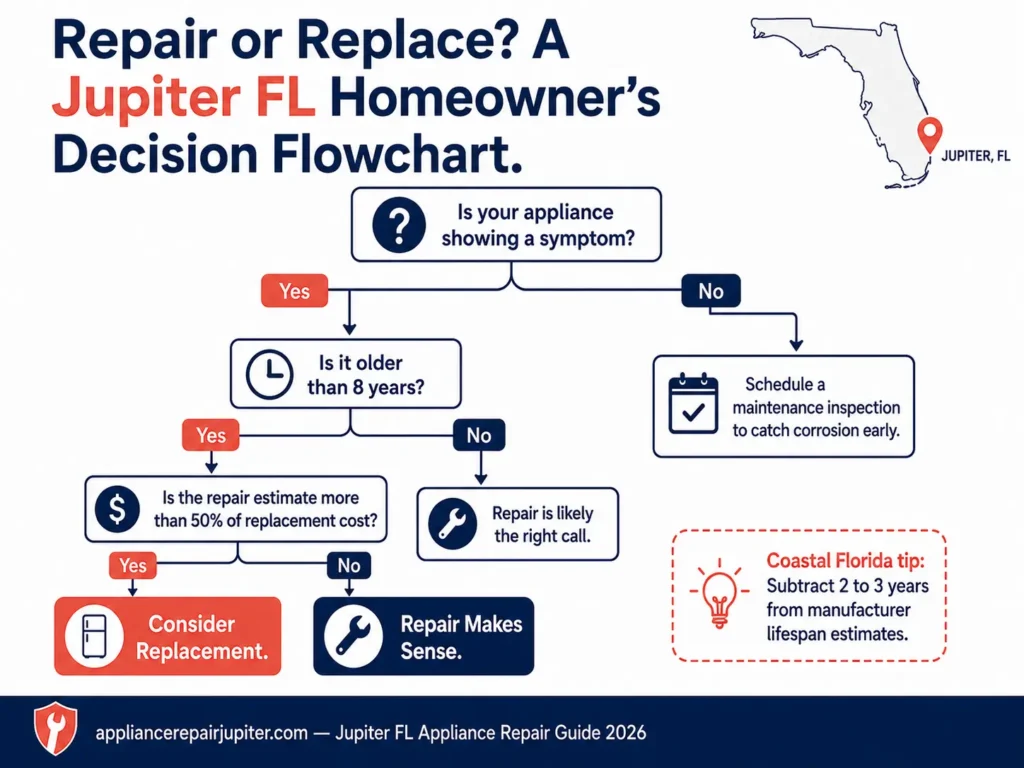
The general rule is to divide the repair cost by the appliance’s remaining useful life. If the repair costs more than 50 percent of what a new machine would cost, and the unit is already past the halfway point of its expected lifespan, replacement usually makes more sense. That rule needs to be adjusted for Jupiter FL conditions, though.
Expected appliance lifespans in Jupiter FL coastal homes run about 20 to 30 percent shorter than national averages. A refrigerator rated for 14 years by the manufacturer is realistically looking at 10 to 11 years in a coastal home, possibly less in a Juno Beach oceanfront unit or a Tequesta canal property with high ambient humidity year-round.
So when you are running the math on a repair, use the coastal-adjusted lifespan, not the manufacturer’s number. A 9-year-old refrigerator in Jupiter FL is not at the 65 percent mark of its life the way it would be in Denver. It is probably at the 85 to 90 percent mark. That changes the calculation significantly.
The appliance repair cost estimator on the site lets you plug in your appliance type, age, and symptom and get a repair cost range based on current Jupiter FL market pricing. It is not a replacement for a tech’s assessment, but it gives you a number to work with before anyone comes out.
Here are the specific situations where replacement makes more sense than repair in a Jupiter FL coastal home:
If the compressor is gone on a refrigerator older than 8 years, compressor replacement runs $400 to $800 on most units. That money is better spent toward a new machine.
If the main control board has failed on an appliance older than 6 years and the board cost exceeds $300, you are likely to see a second failure in a different component within 18 months in this climate.
If the drum bearing on a front-load washer has failed and the machine is older than 7 years, bearing replacement is labor-intensive and runs $250 to $400. Worth it on a younger machine, not worth it on an older coastal one.
The appliance lifespan guide for Jupiter FL goes into the specific numbers by appliance type and gives you the coastal-adjusted lifespans that actually apply to homes in this area.
How to Slow the Damage Down Without Spending a Fortune
The most effective things you can do to extend appliance life in a Jupiter FL coastal home cost almost nothing: clean condenser coils twice a year, run a monthly dishwasher descaling cycle, leave front-load washer doors open between cycles, and install a surge protector at the panel before the next storm season starts.
Let me be specific about each one, because generic advice is not helpful in a coastal Florida environment.
Condenser coil cleaning. Pull the refrigerator out from the wall twice a year. Once in spring before the heat arrives, once after hurricane season ends in November. Use a coil brush and a vacuum. In a Tequesta canal home or an Abacoa townhome where humidity is constantly elevated, the coils collect more than dust. They collect salt-laden particles that stick and hold moisture. This is not optional maintenance here. It is the single highest-return thing you can do for your refrigerator’s lifespan.
Dishwasher descaling. In Palm Beach County water, running a citric acid descaling cycle once a month is reasonable. Commercial products exist specifically for this, or plain white vinegar works in a pinch, though citric acid is more effective on heavy mineral deposits. Do it monthly, not annually.
Front-load washer door gasket. Leave the door cracked open between every single cycle. In Jupiter FL humidity, a sealed wet gasket grows mold fast. Roughly twice as fast as in an inland climate. Wipe the gasket with a dry cloth after the cycle and leave the door open. It takes thirty seconds. The alternative is a mold remediation job that runs $200 to $400 and still leaves the gasket questionable.
Surge protection. Talk to a licensed electrician about a whole-home surge protector before June. The cost is typically $300 to $600 installed, and it covers every appliance in the house for years. One bad storm event that takes out a refrigerator control board and a dishwasher main board costs more than that in a single afternoon. This is especially true for homes in Jupiter Farms or North Palm Beach where proximity to power lines can mean repeated momentary outages during storm season.
The appliance maintenance checklist generator on the site builds a custom checklist based on your appliance types and the current season. It is the fastest way to get a specific list without sorting through general advice that may not apply to a coastal Florida home.
One honest note here: even if you do all of these things, your appliances in Jupiter FL will still have a shorter lifespan than the manufacturer’s rating suggests. That is just the reality of the climate. The maintenance slows the damage down. Setting realistic expectations about when a machine is approaching end of life is part of not getting blindsided by a repair bill that would have been better spent on a replacement.
Frequently Asked Questions
Does salt air really damage appliances, or is that overstated?
It is not overstated. Salt air in coastal Florida homes measurably accelerates corrosion on metal components inside appliances. The homes closest to the Jupiter Inlet, the Intracoastal, and the Juno Beach shoreline see the fastest deterioration, but even homes a few miles inland are affected by the ambient humidity that carries salt particles through ventilation systems and around door seals.
How long should my refrigerator last in a Jupiter FL coastal home?
National averages put refrigerator lifespan at 13 to 14 years. In a coastal Jupiter FL home, the realistic expectation is 9 to 11 years, depending on proximity to the water, how often the coils are cleaned, and what the water quality is like at your address. The appliance lifespan page has coastal-adjusted numbers for every major appliance type.
Why does my dishwasher leave white film on everything?
In Palm Beach County, that is almost always mineral scale from hard water. The water hardness in this county runs between 180 and 250 ppm, classified as very hard. The film is calcium and magnesium deposits. A good rinse aid and monthly descaling cycles help with the visible symptoms. If the buildup is already heavy on your heating element, a tech visit to clean and inspect is worth scheduling.
Can I clean my own condenser coils, or do I need a tech for that?
You can do it yourself on most refrigerators. Pull the machine out, locate the coils at the back or behind the bottom front panel, and use a coil brush and vacuum. Take your time around the refrigerant lines. If the coils are corroded rather than just dusty, that is worth having a tech look at. Corroded coils affect efficiency in ways that go beyond what cleaning alone can fix.
Why does my front-load washer always smell moldy in Florida?
Jupiter FL humidity and the sealed design of front-load machines create near-perfect conditions for mold growth in the door gasket. The gasket stays damp, the humidity in the laundry area stays elevated, and the door seal traps moisture between cycles. Leave the door open between every use, wipe the gasket after each cycle, and run a drum cleaning cycle monthly. If the mold is already established in the gasket folds, you may need a gasket replacement. More on washer issues here.
My appliance is showing an error code. Could that be related to corrosion?
Sometimes, yes. Error codes related to sensor failures, communication errors between the board and the motor, or temperature readings that do not match expected values can all trace back to corrosion on the control board or wiring harness connectors. The error code decoder gives you a starting point, and a tech can confirm whether the code points to a corroded component or something else.
How much does a control board replacement cost in Jupiter FL?
The range is wide depending on the appliance and brand. Refrigerator main boards typically run $150 to $450 for the part, plus $80 to $120 in labor. Washer and dryer control boards are usually $120 to $350 for the part. The cost estimator gives you a range based on your specific appliance type before you call anyone.
Is it worth repairing an appliance that is 10 years old in Jupiter FL?
Depends on what is wrong. A 10-year-old refrigerator in Jupiter FL is near the end of its realistic coastal lifespan. Minor repairs like a door seal, a water inlet valve, or an ice maker component can still make sense. A compressor or main board replacement at that age usually does not. The repair-versus-replace calculator on the cost estimator page can help you work through the numbers.
Do surge protectors actually protect appliances during Florida storms?
Whole-home surge protectors installed at the panel give meaningful protection against most voltage events. Plug-in strip protectors give very limited protection and almost none against a nearby lightning strike. In Jupiter FL’s storm season, panel-level protection is the right answer. Individual appliance protectors can supplement for high-value machines, but they are not a substitute for panel protection.
What brands hold up best in Jupiter FL coastal conditions?
Honestly, no brand is immune to coastal corrosion. That said, machines with fewer electronic components and more straightforward mechanical construction tend to hold up longer in high-humidity environments. Top-load washers with simple agitator designs outlast front-loaders in most coastal Florida scenarios. Among refrigerators, models with fewer smart features tend to age better. The smart features add circuit board surface area that is more vulnerable to humidity.
How often should appliances be serviced in a Jupiter FL home?
Annual coil cleaning for refrigerators at a minimum. Every two years for dishwashers, covering descaling and inspection. As-needed for washers and dryers based on what you hear and see. Homes within a half-mile of the water or on a canal should do refrigerator coil cleaning every six months, not annually.
My appliance started having problems right after a power outage. Are they related?
Very likely. Power restoration after an outage involves a surge as the grid reconnects. Compressor start capacitors and control boards are the most vulnerable components during these events. If your appliance started behaving differently within a day or two of a power outage, the outage is probably the cause. Reach out here to get a tech out to check the specific components at risk.
Is the water quality in Jupiter FL hard enough to cause real appliance damage?
Yes. At 180 to 250 ppm, Palm Beach County water is in the very hard category. Over time, that mineral load causes scale buildup on heating elements, in water lines, and on valve components in dishwashers, washing machines, and refrigerator water dispensers. A whole-home water softener addresses this comprehensively. If that is not in the budget, targeted maintenance including monthly descaling and annual valve inspection helps manage it.
Why did my appliance fail at 7 years old when the manufacturer said it should last 14?
Manufacturer lifespan ratings are based on controlled test conditions that do not account for coastal humidity, salt air, hard water, or repeated power events during storm season. In a coastal Jupiter FL home, it is not unusual for appliances to reach functional end-of-life at 8 to 10 years. That is consistent with what techs across this area see regularly, not a reflection of a defective unit.
Can hard water damage my LG or Samsung refrigerator’s water dispenser?
Yes. Scale builds up in the water line and filter housing over time, restricting flow to the dispenser and to the ice maker fill valve. If your dispenser flow has slowed or your ice maker is producing smaller cubes, scale in the water line is the first thing to check. For LG units and Samsung models specifically, this is a recurring issue in Palm Beach County homes.
What should I do immediately after a hurricane or major storm?
Do not immediately restart appliances that were running when the power went out. Let the power stabilize for a few minutes before turning refrigerators and freezers back on. Check for any burning smell or visible damage before running dishwashers or washing machines. If power was out for more than 12 hours, treat refrigerator contents as questionable and do not rely on appearance alone. If anything starts making an unfamiliar sound after power is restored, turn it off and call a tech before running it again.
One More Thing Before You Go
If you are reading this because something in your home already stopped working, or because you heard an unfamiliar noise this week and started wondering what is actually happening inside your machines, that is a reasonable place to be. This climate is harder on appliances than most people expect when they move here, or when they buy something new and assume it will last as long as the box says.
The damage is manageable. The coil cleaning, the door gasket habits, the descaling cycles — none of it is complicated. What is complicated is staying ahead of it when you do not know what to look for. That is what this post is for.
If you want a custom maintenance schedule based on your specific appliances, the maintenance checklist generator is a good starting point. If something already needs attention, reach out here and we will connect you with a local tech who knows this area.
One Comment